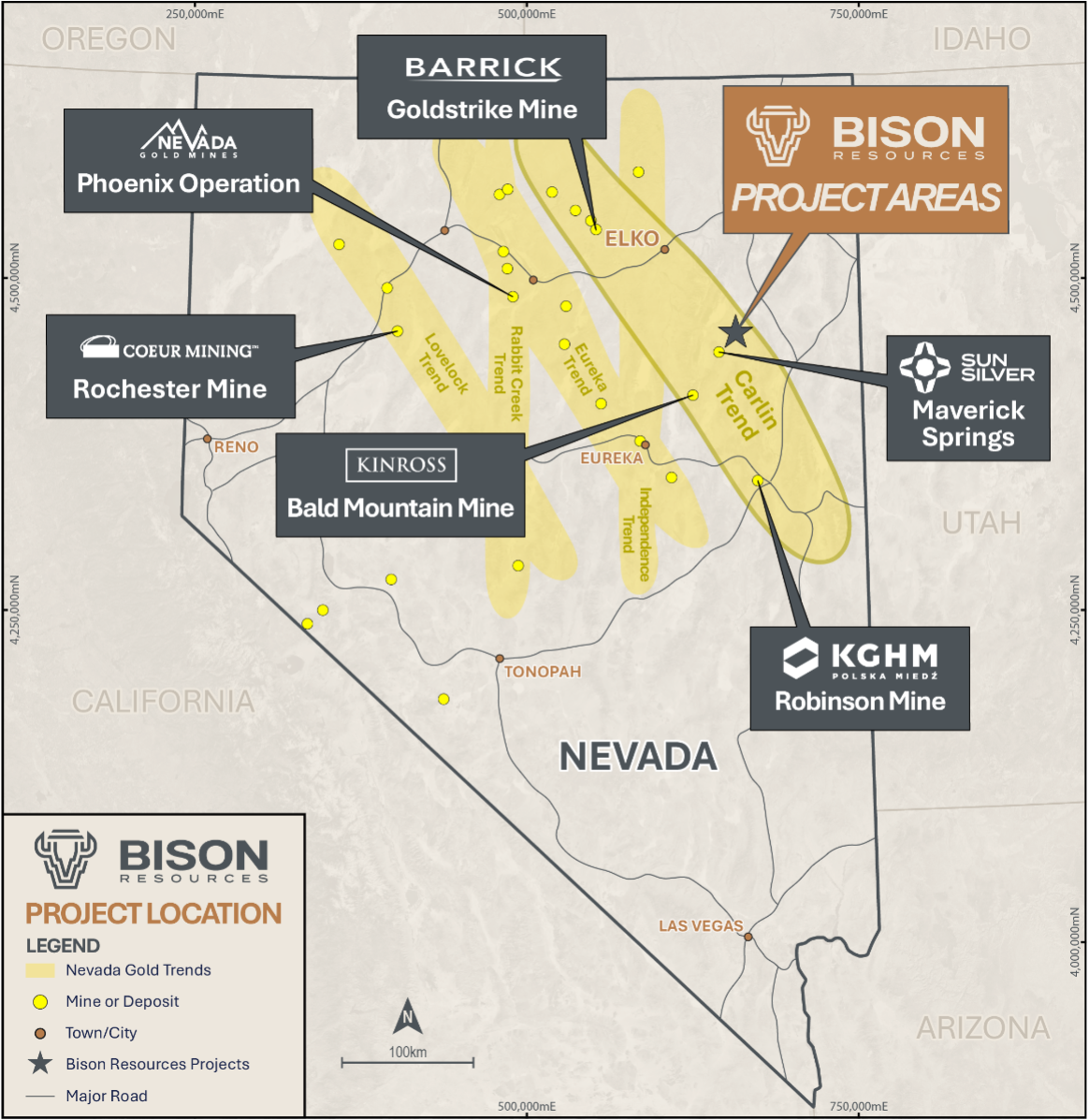
Bison Resources has 4 properties in northeast Nevada within the prolific Carlin Trend that is host to the massive gold-silver ‘Goldstrike’, ‘Bald Mountain’ and ‘MaverickSprings’ deposits, as well as the porphyry copper-gold ‘Robinson’ deposit. Bison is targeting massive carbonate-hosted precious metals deposits within claims that encompass similar host geology and structural settings to Nevada’s largest gold and silver deposits.
• 80km from the town of Elko, Nevada, a fully-serviced gold mining town
• All claims within 5km from sealed roads
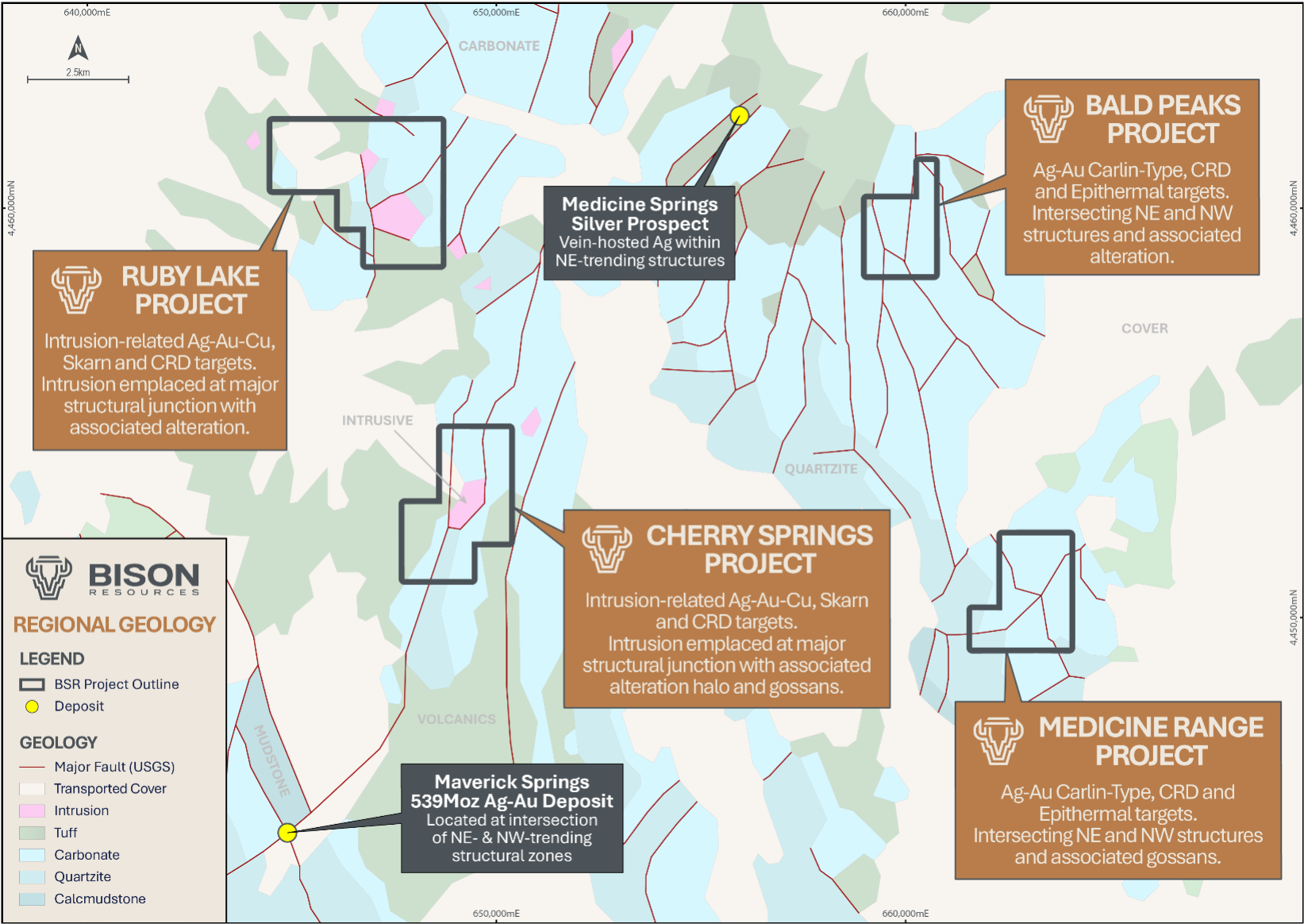
All of the projects have extensive alteration signatures at surface which has been identified from utilising hyperspectral imaging. These signatures are key indicators of massive Carlin Type mineral systems. All of the projects are located within the same mineralisation trend as the nearby major deposits of: Goldstrike, Maverick Springs, Bald Mountain, and Robinson. They encompass major structural corridors, intrusions and host rocks conducive to massive gold-silver deposits. The project lithologies are the same as those that host mineralisation at Bald Mountain, Maverick Springs and Robinson which are some of the largest precious metal deposits in Nevada. Nevada consistantly ranks every year among the best mining jurisdictions globally according to the Fraser Institute Annual Survey of Mining Investment Attractiveness and produces roughly 75% of the United States’ gold.
All four of the projects contain major structural corridors with multiple cross-cutting faults that provide optimal fluid pathways for large mineral systems. The faults are predominantly orientated northeast and northwest, consistent with other major deposits within the Carlin Trend. The regional geology comprises carbonate sequences that are prime hosts for carbonate replacement (CRD), epithermal, skarn and porphyry deposits. The Carlin Trend represents a deep seated crustal boundary that separates thick, stable continental crust to the east from thinned transitional crust to the west resulting in a major mantle tapping fluid pathway.
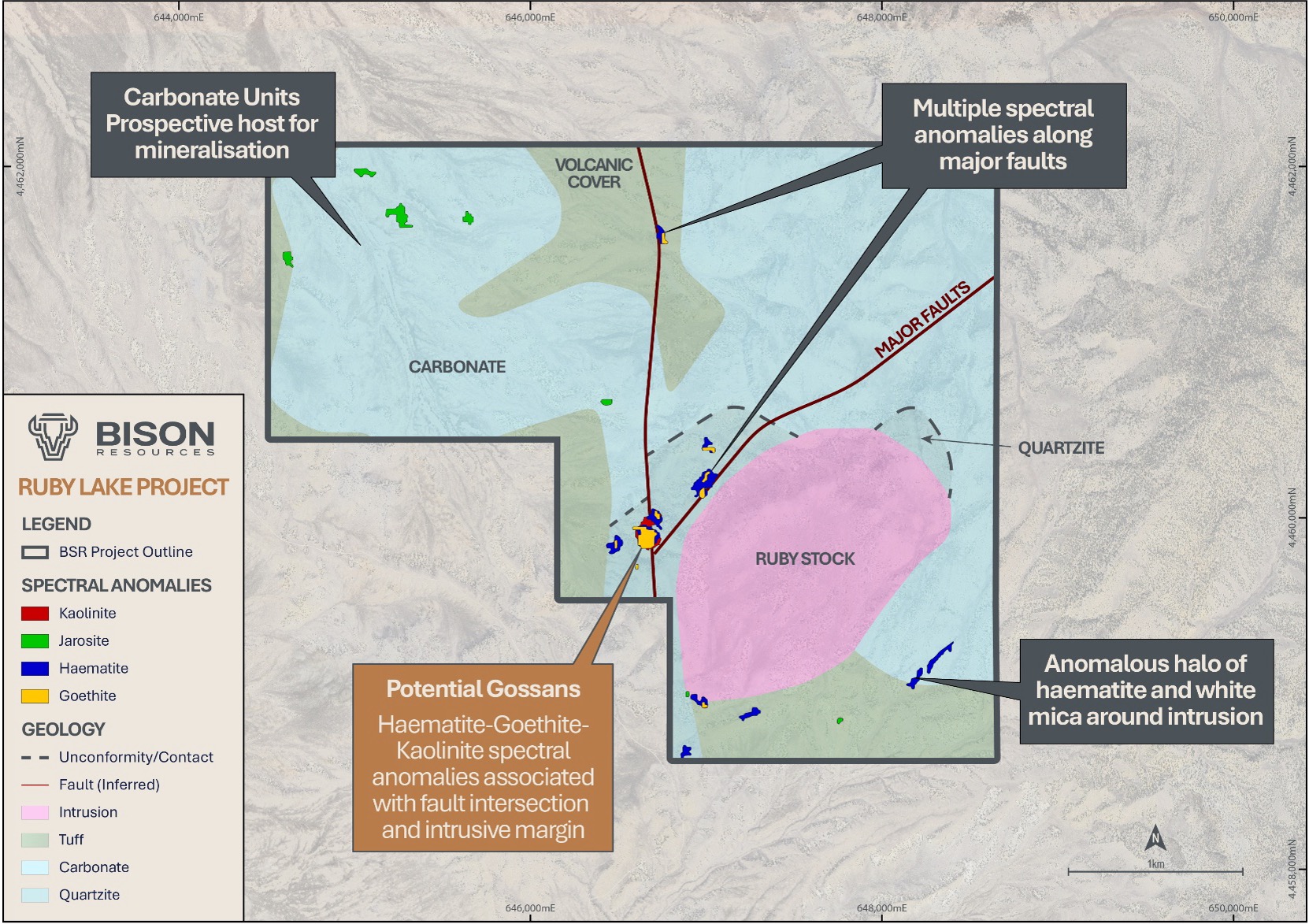
Setup for a major precious metal discovery:
Hyperspectral data has revealed a haematite alteration halo within the carbonate units directly adjacent to the intrusion.
Distinct zoned kaolinite-haematite-goethite anomaly coincident to the structural junction – possible gossanous material.
Potential for Au-Ag-Cu porphyry, carbonate replacement and skarn deposit styles.
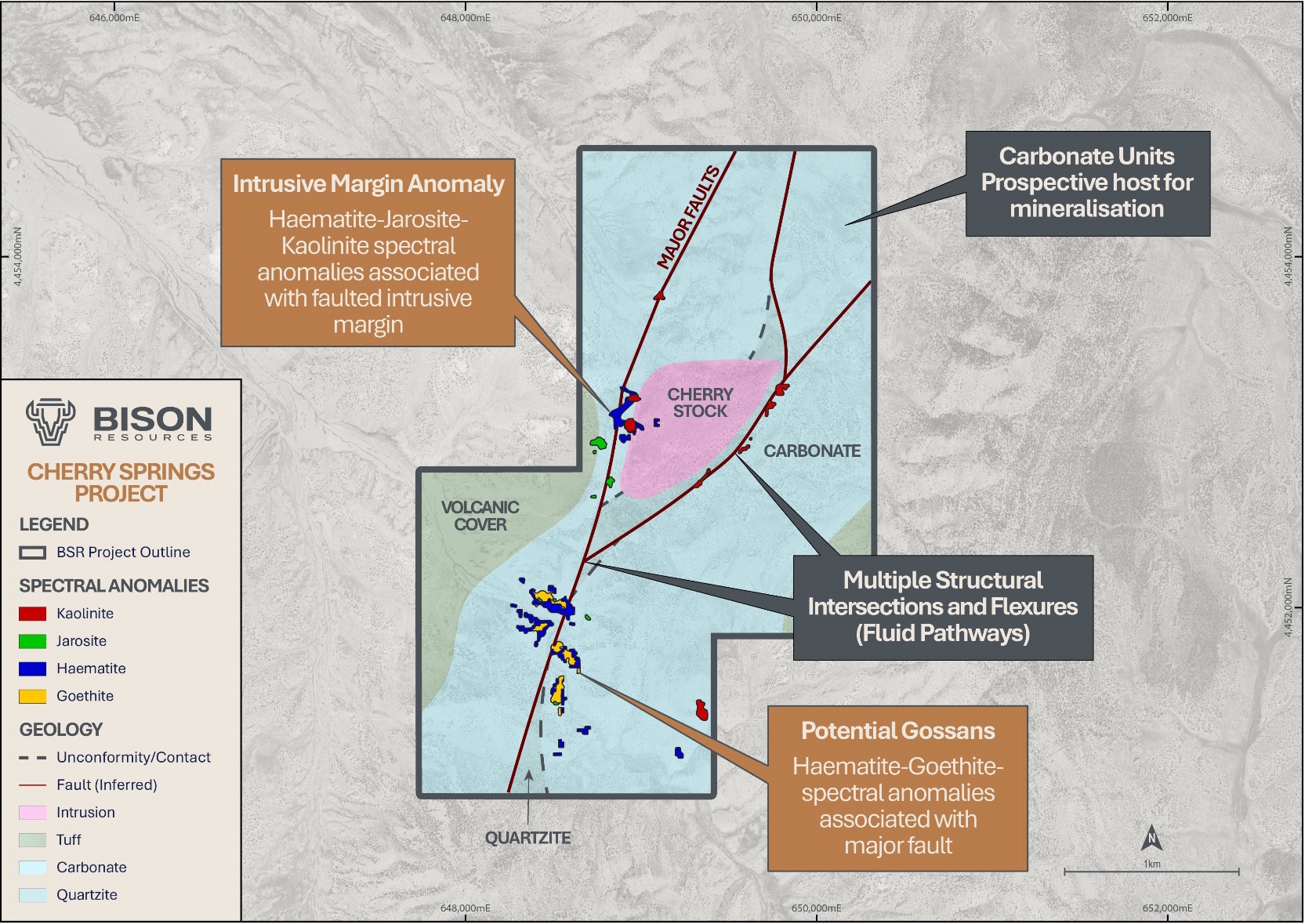
Ingredients of a major mineralised system:
Haematite-goethite anomalies associated with the primary fault in the south – potential gossans.
Kaolinite-dominant spectral alteration halo surrounding the intrusive margin.
Potential for Au-Ag-Cu porphyry, carbonate replacement and skarn deposit styles.
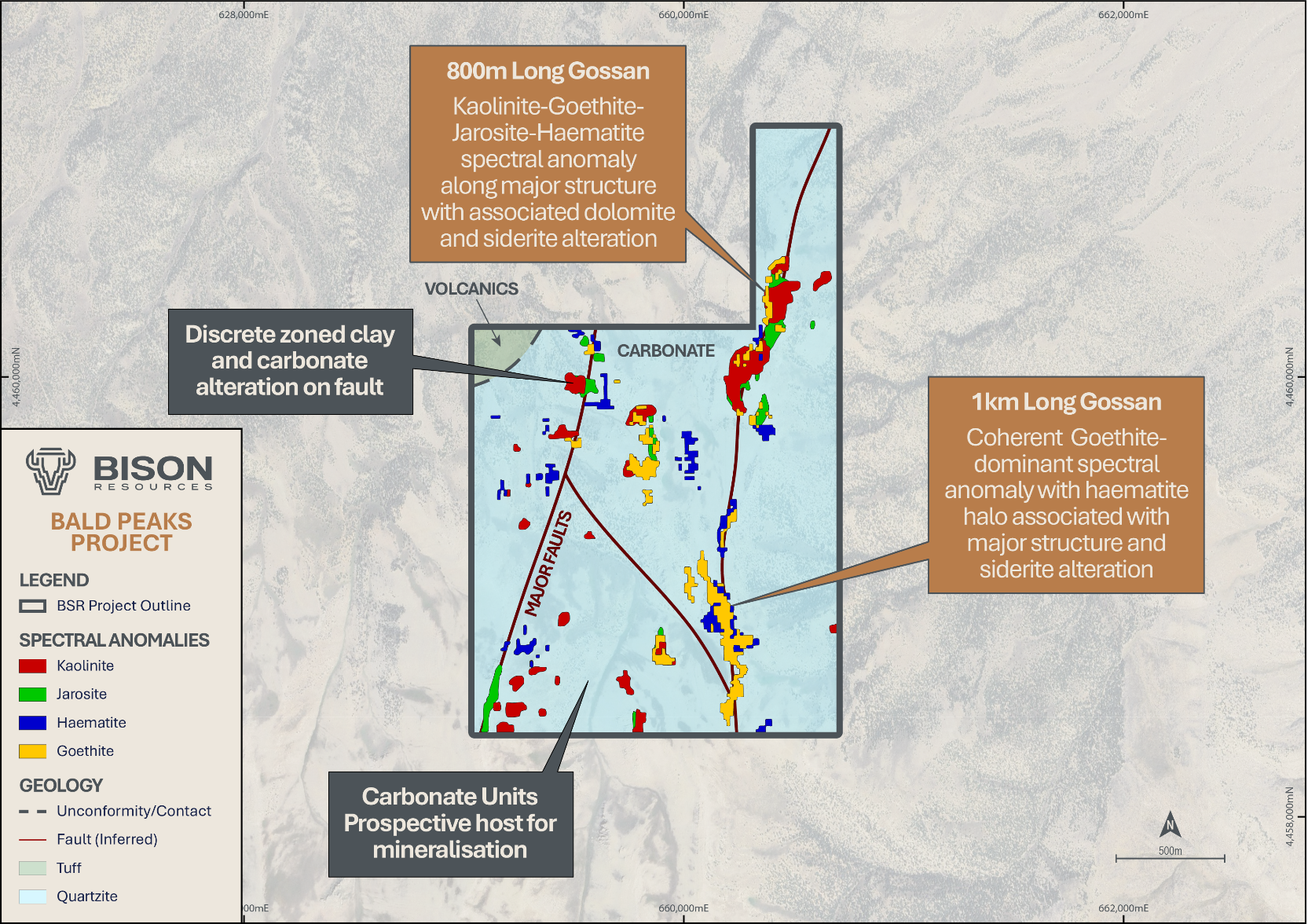
Large-scale, walk-up targets:
Clay and carbonate alteration assemblages suggest major hydrothermal activity across the Project area.
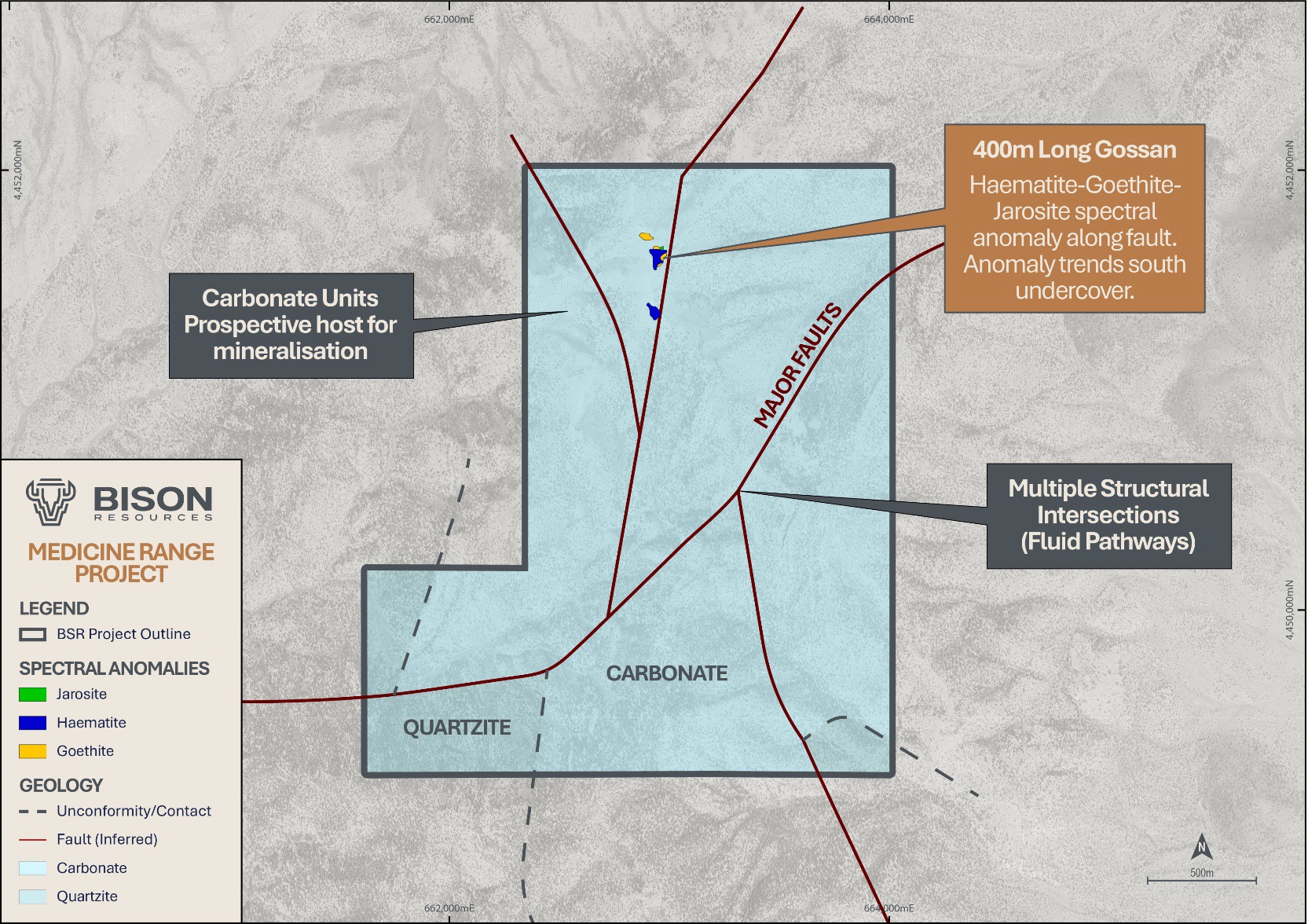
Potential for epithermal, carbonate replacement, Carlin-Type and skarn deposit styles.
From-surface mineralisation indicators:
Hyperspectral anomaly exhibits zonation, with a haematite core and goethite halo.
Potential for epithermal, carbonate replacement, Carlin-Type and skarn deposit styles.